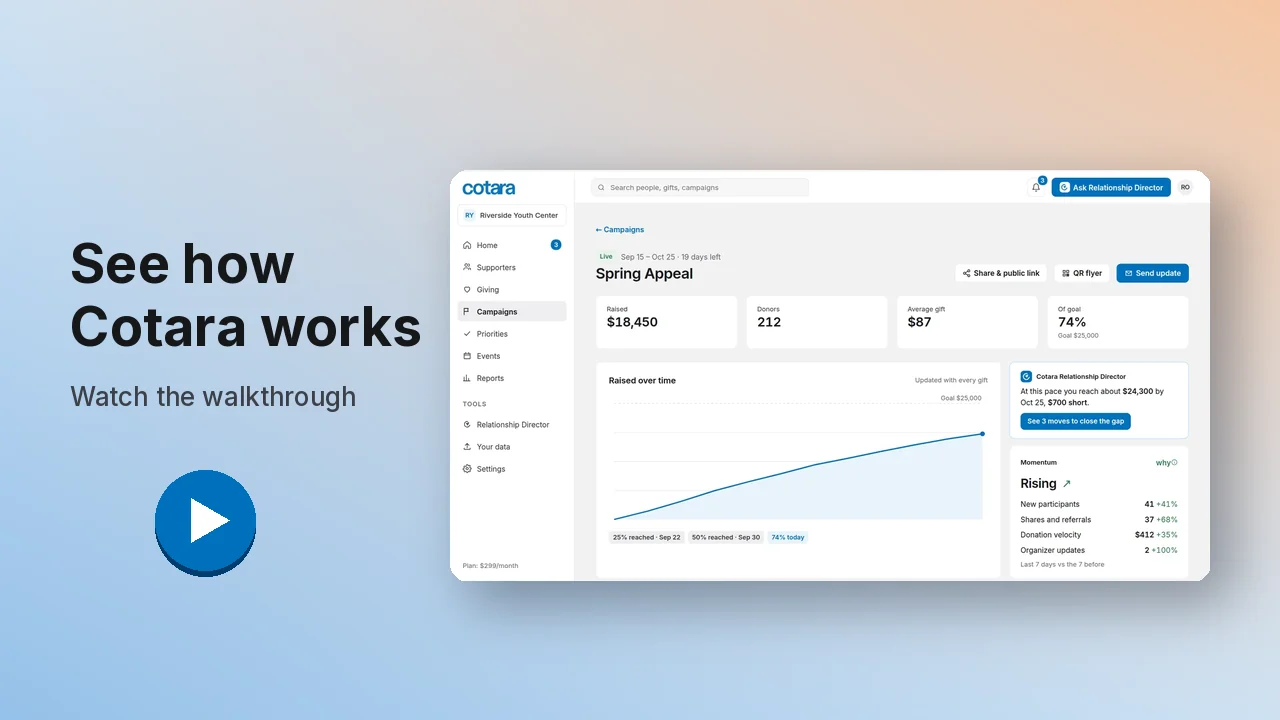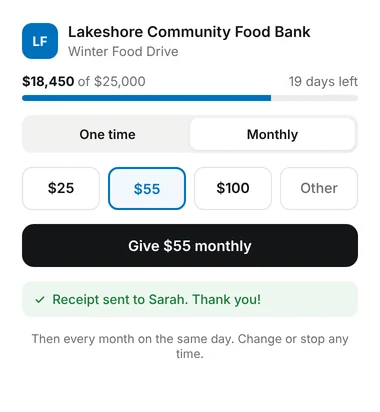
Sarah gives for the first time.
$55 a month from her phone. The receipt goes out on its own.


Raise money, keep supporters engaged, and see what to do next.
$55 a month from her phone. The receipt goes out on its own.
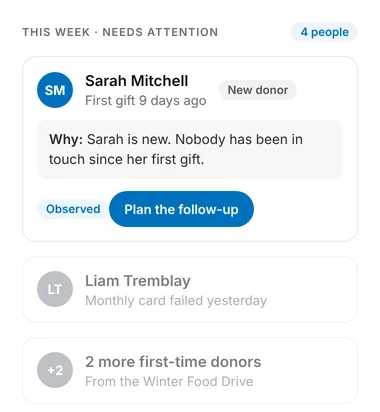
Sarah is new and nobody has been in touch since her first gift. Cotara shows why she needs attention.
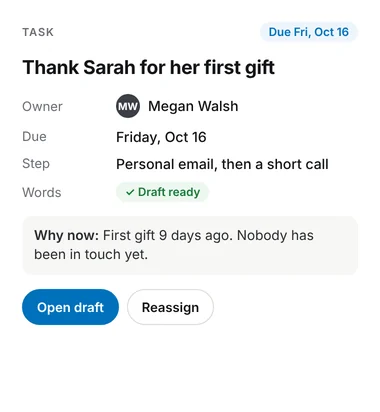
She gets the task, the words and a due date.
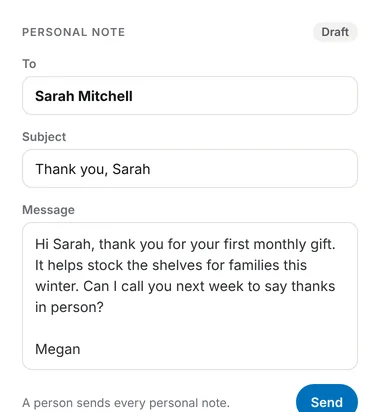
She edits the thank-you and sends it from her own email.
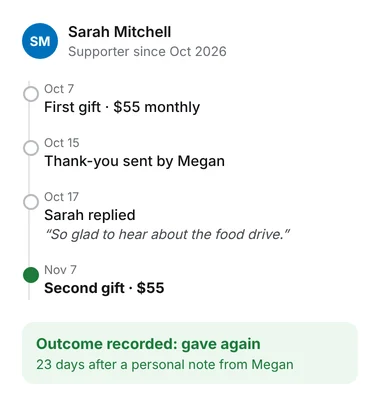
It links each follow-up to what happened next, so you can see which ones bring people back.
A gift gets recorded.
The next step shouldn’t depend on someone remembering.
Plenty of donor information. More work deciding what to do with it.
Know who needs attention, why, and what to do next.
Sarah is one of your steadiest supporters.
Keeping supporters engaged is the harder part. Cotara is being built to help small fundraising teams know who needs attention and make the follow-up happen.
Donors who gave in 2024 and returned in 2025.
Fundraising Effectiveness Project, Q4 2025Case studyNew donors from 2024 who returned in 2025.
Fundraising Effectiveness Project, Q4 2025Case studyPreviously established donors who returned in 2025.
Fundraising Effectiveness Project, Q4 2025Case studyMonthly and one-time giving, event and QR giving. Receipts go out on their own.
What supporters tell you in answers, replies and notes stays with their record.
Volunteer sign-ups and event attendance sit beside the gifts.
Knows who to thank, call or update, with the words ready to edit.
Hear what supporters care about and why they give.
Steady support keeps the meals, tutoring and care going.
Keep your payments, email and records where they are. Cotara connects to them and adds the next step.
Bring in the data you already have, and keep working in the tools your team knows.
Send supporter and gift data to Cotara and read back the next steps.
POST /v1/gifts
{ "supporter": "maya@example.com",
  "amount": 5000,
  "currency": "usd",
"frequency": "monthly" }Half a million new donors. Experts predicted an 80% lift. The calls changed nothing.
Four in five first-time donors from 2024 didn’t give again in 2025. Start with the number you can measure.
See your overall and first-time donor retention against the 2025 benchmarks. No sign-up.
PlanningA one-question survey beats guessing. But the people who answer are rarely the people you most need to hear from.
Two monthly donors miss a payment in the same week. On your report they can look the same. They may need very different things.

Two monthly donors miss their gift in March.
The first, Mark, has given $25 a month for fourteen months. His card expired in February and the bank issued a new one. He doesn’t know his gift failed.
The second, Anne, has given $40 a month for three years. Her card is fine. She cancelled it with her bank on purpose, because something about your last email didn’t sit right with her.
On your payment report, Mark and Anne can look very similar. Both gifts are missing. Both people may get the same automatic email. And that email is wrong for at least one of them.
Most failed monthly gifts happen for ordinary reasons. The card expired. The bank blocked a charge it didn’t recognize. The donor got a new card after a fraud alert. Some payment processors update expired cards automatically when the bank shares new details, but that doesn’t catch every case.
None of these is a choice to stop giving. Mark needs a service, not a conversation. A short, friendly note from a real person with a link to update his card is enough.
Anne is different. She chose to stop. If she gets a cheerful “your card needs updating” message, it tells her nobody is paying attention. That can turn a quiet exit into a bad one.
A failed payment tells us that money didn’t arrive. Sometimes the reason is technical. Sometimes a supporter has intentionally stopped giving. The payment record may give us clues, but it doesn’t necessarily tell us what the person intended. That’s where the next conversation matters.
Banks often share very little about why they refused a charge. Meanwhile the person who knows Anne, and might have noticed the email that upset her, never hears that her gift stopped.
I can’t tell you how many failed gifts in a typical organization are card problems and how many are quiet cancellations. I haven’t seen good public data on it, and I suspect it varies a lot. That’s exactly why it’s worth checking your own. Pull the last 90 days of failed gifts, read what the records say, ask a few of the people involved, and see what you find.
Mark and Anne both stopped giving in March. Only one of them meant to.
Mark and Anne are composite examples. Names and details are illustrative.
Book a 30-minute demo and we will show you with your own donor file.
Book a DemoTunde gave $60 to the spring appeal. He got a receipt within a minute. Then nothing.
Six months later the autumn appeal arrived in his inbox. It was the first time the charity had written to him since the receipt. It asked him for money.
Tunde did not give again. He did not decide against it. He just felt like a stranger being asked for a favour.
Most teams treat a first gift as the end of a campaign. The money is counted, the receipt goes out, and the team moves on to the next appeal.
For the donor, the first gift is the start. They took a small risk. They want to know what happened to it, and whether anyone noticed.
The gap between the first gift and the next message is where donors drift away.
The next ask comes after the donor has heard from you at least three times.
Look at the people who gave for the first time last year. How many gave again? That is your baseline. Write it down. Then choose the next five first-time donors and give each of them the plan above. In three months, compare.
Cotara spots first-time donors who have not given again. It drafts a short welcome series for you: emails and a call script. You edit the words and send them from your own email, on your own schedule.
Any gift from the same person after their first one, in any campaign. Count it over a fixed window, for example twelve months, so you can compare year to year.
No. A two-minute thank-you call to a new donor is one of the best uses of staff time. Start with the ten most recent donors and see how it feels.
After the donor has heard from you at least three times without an ask. The exact gap depends on your calendar. The rule is to give before you ask.
Tunde is a composite example. Names and details are illustrative.
Book a 30-minute demo and we will show you with your own campaign.
Book a DemoA declined card is rarely a decision to stop. Here is how to keep the donor.
EventsMany of your guests may be people you have never met. Do not lose them.
ReportsOne page, five parts, and a date you set on day one.
We know who bought the tables and what the night raised. We rarely know who came because someone they trusted asked them.
Something interesting happens at fundraising events, and most of us don’t record it.
A community food bank holds a gala for 180 people. The team knows about 120 of them. The other sixty came as guests of table hosts. One of those hosts, a long-time volunteer named Carol, filled her table with neighbors who had never heard of the food bank.
The next morning, everyone who bought a ticket gets a thank-you. The sixty guests get nothing. Their names are on a paper sign-in sheet. And nowhere in the database does it say that six of them came because Carol asked.
The guest list tells you who attended. It doesn’t tell you why. Carol may have been the reason those neighbors first walked through the door. What happened afterward could tell us whether that introduction developed into a relationship with the organization.
When we lose that link, two things go wrong. We follow up with the guests as if they were strangers, and we never thank Carol for the thing she actually did, which was to vouch for us.
There’s evidence that how we invite supporters to bring others in matters. In a field experiment with 77,485 donors, published in Marketing Science in 2023, Ike Silver and Deborah Small tested two versions of a request to share a donation. The standard version asked people to share. The other told donors their gift could start a chain reaction.
The chain-reaction version increased click-through by 5.1% and the likelihood of recruiting at least one later donation through word of mouth by 12.4%. That’s one experiment, online, with one organization’s donors, so I wouldn’t treat it as a rule. But it supports something I believe: the person who brings someone else is doing real work for your cause, and the way we ask shapes whether they do it.
Six months later, you’ll be able to ask a question most organizations can’t: which of our supporters bring others in, and what happens to the people they bring?
The food bank and Carol are composite examples. Names and details are illustrative.
Book a 30-minute demo and we will show you with your own donor file.
Book a DemoRuth is the executive director of a youth centre. Her Spring Appeal report was due on November 24.
She wrote it on November 23, after the children had gone home. It was fourteen pages. It had every number she could find.
At the board meeting, the chair turned to page one and asked a single question: "Did we do what we said we would do?" The answer was somewhere on page nine.
Most reports are written from memory at the deadline. They list what the team did, not what the team promised. Nobody checks whether the report arrived on time. And the board reads the first page, so the first page decides everything.
Everything else goes into an appendix, for the people who want it.
When you launch a campaign, choose the report date and tell your donors. Now the report is a promise, and a promise gets done. Keep a simple count: how many campaigns did we report on time? A board likes a number like "4 of 4".
Keep a running note during the campaign. Two lines a week: what happened and what you decided. When the deadline arrives, most of the report is already written.
Take your last report. Cut it to one page using the five parts. Show it to one board member and ask what they would still want to know.
Cotara tracks every campaign against its report date and shows how many you sent on time. When a report is due, it drafts one from your results. You review it, edit it and send it.
One page for the main report, with an appendix for details. If the board cannot find the answer to "did we do what we said?" in thirty seconds, shorten it.
Give donors a shorter, warmer version of the same facts: what you promised, what you raised and what you did with it. Send it by the date you promised.
Say so on page one. Explain what you learned and what you will change. Boards trust honest reports more than perfect ones.
Ruth is a composite example. Names and details are illustrative.
Book a 30-minute demo and we will show you with your own campaign.
Book a DemoA declined card is rarely a decision to stop. Here is how to keep the donor.
Donor retentionA receipt is not a welcome. A simple 30-day plan for first-time donors.
EventsMany of your guests may be people you have never met. Do not lose them.
A family gave every week until June. After August they gave nothing. By then they had also stopped coming on Sundays.
The church treasurer saw it in November, while preparing year-end tax receipts. She mentioned it to nobody. It was not her role, and it felt private.
In February the pastor learned that the father had lost his job in the summer. The family had needed help for six months.
The first sign of trouble was in the giving record. It was read as a finance report, by the one person who does not do pastoral care. The people who care for others never saw it.
This is not a case for pastors to watch what people give. Many churches rightly keep amounts private. It is a case for a small, careful step between the finance office and the care team.
Put it in plain words in your member guide. "We look for changes so we can care for you. We never discuss what you give." Members who know the rule trust it.
Ask your treasurer and your care lead to meet for fifteen minutes. Agree who receives a "pattern changed" note, how often, and what the first response will be. Write it on one page.
Cotara shows which supporters' giving has changed and suggests a short, caring note or call. You choose who sees what. Your team sends the message and records what happened.
It can be, if members know about it, the finance office keeps amounts private, and the only purpose is care. Check with your leadership and, where needed, your denomination or legal adviser.
That is the most common outcome. A kind check-in costs little and is rarely unwelcome. Never mention giving in the conversation.
One trusted person on the care team, not a committee. Fewer people means more privacy and a faster response.
This family is a composite example. Names and details are illustrative.
Book a 30-minute demo and we will show you with your own campaign.
Book a DemoA declined card is rarely a decision to stop. Here is how to keep the donor.
Donor retentionA receipt is not a welcome. A simple 30-day plan for first-time donors.
EventsMany of your guests may be people you have never met. Do not lose them.
A one-question survey beats guessing. But the people who answer are rarely the people you most need to hear from.
A community center was planning its 2027 campaigns. The board chose three priorities in one meeting, from experience and instinct. One member was sure parents cared most about the Saturday STEM club. Another thought it was the meal program. Nobody asked a parent.
So the next year, they did. They sent one short question to their email list: “What should we focus on in 2027?” Ninety people answered. The STEM club won easily.
Then someone looked at who had answered.
Most of the ninety were long-time donors and volunteers. Very few were families who used the meal program, because most of those families weren’t on the email list. Some didn’t read English comfortably. Some had never been asked anything by the center before.
The survey told them what the respondents thought. The mistake was assuming the respondents spoke for the whole community. It reached the people who were already closest to the organization, and their view was treated as everyone’s.
Tell everyone what you decided and why, including the people whose favorite didn’t win. “Donors told us STEM club. Families at the meal program told us meals. Here’s how we’re funding both.” People who see their answer used are more likely to answer next time.
The board may still choose the same priorities. The difference is that now they’ll know whose priorities they are.
This community center is a composite example. Names and details are illustrative.
Book a 30-minute demo and we will show you with your own donor file.
Book a DemoThese terms form the agreement between Cotara Finance Technology LLC ("Cotara", "we", "us") and the organization that uses Cotara ("you", "Customer"). Read them before you create an account.
Cotara is fundraising software for nonprofit and mission-driven organizations. You may use Cotara only for a business or organizational purpose. The person who accepts these terms must have authority to bind the organization.
These terms apply to the Cotara website, the Cotara application, Cotara Relationship Director, and any related service (together, the "Service").
The Cotara plan costs $299 per month. Cotara Relationship Director is included at no extra charge. All prices are in US dollars and exclude taxes.
Cotara uses Stripe to process donations and subscription payments. Your use of Stripe is also subject to Stripe's own terms. Stripe sets and charges its own processing fees.
Donations go to your organization through your Stripe account. Cotara does not hold donated funds on your behalf and is not a bank or money transmitter.
You are responsible for how you raise and use money and how you contact people. In particular, you must:
You own your data. This includes supporter, donation, event and campaign information that you or your supporters put into Cotara ("Customer Data"). You give Cotara the right to host, process and display Customer Data only to run, secure and support the Service for you, and as the law requires.
When we process personal information in Customer Data for you, we do so on your instructions. Our Privacy Policy and Data Governance pages describe how. If your law requires a data processing agreement, ask us and we will sign one.
Cotara Relationship Director suggests who to contact and what to say. It may be wrong or incomplete. A person on your team must review every suggestion before it is used. Cotara does not send a message to a supporter unless a person on your team approves it. You are responsible for what you send.
You must not use the Service to:
We may suspend an account that breaks this section. Where we can, we will tell you first.
Some features are marked "Early access". They may change, be incomplete, or be withdrawn. We provide them as they are, and we welcome your feedback on them.
Cotara, its software, design, name and logo belong to Cotara. These terms give you a limited, non-exclusive right to use the Service for your organization while you have an active plan. You may not transfer that right. If you give us feedback, we may use it without payment or obligation to you.
Each side will keep the other's non-public information confidential, use it only for the purpose of these terms, and protect it with reasonable care. This does not apply to information that is public through no fault of the receiver, or that the law requires a side to disclose.
We work to keep the Service available and secure, but we do not promise that it will run without interruption or error. We may carry out maintenance, and we will try to give notice of planned work. Contact us at hello@usecotara.com for support.
To the full extent the law allows, we provide the Service "as is" and "as available". We do not give any warranty, express or implied, including any warranty of merchantability, fitness for a particular purpose or non-infringement. We do not promise any level of donations, growth or fundraising result.
To the full extent the law allows, neither side is liable to the other for indirect, special, incidental or consequential loss, or for lost profit or lost donations. Cotara's total liability for any claim connected with the Service is limited to the amount you paid Cotara in the 12 months before the event that gave rise to the claim. These limits do not apply to liability that the law does not allow a party to limit, or to your duty to pay fees.
You will defend and compensate Cotara against claims by a third party that arise from your Customer Data, your fundraising activity, or your breach of these terms. We will tell you promptly about any such claim and give you reasonable help.
You may stop using Cotara at any time. We may end the agreement if you break these terms and do not fix the problem within 15 days of our notice, or at once for serious or repeated breach, fraud or legal risk.
After the agreement ends, you can export your Customer Data for 30 days. After that, we delete it as set out in our Data Governance page. Sections that by their nature should continue (for example sections 10, 11, 13, 14, 15 and 18) continue after the end of the agreement.
We may update these terms. For a material change we will give you at least 30 days' notice by email or in the Service. If you keep using the Service after that date, you accept the new terms. If you do not agree, you may cancel before the change takes effect.
The laws of the State of Texas, United States, govern these terms, without regard to conflict-of-law rules. The state and federal courts located in Texas have exclusive jurisdiction over any dispute, and each side agrees to that jurisdiction. Before either side starts a claim, both sides will first try in good faith to resolve the matter by direct discussion for 30 days.
These terms, with any order form we agree with you, are the whole agreement between us on this subject. If a part is found to be unenforceable, the rest stays in force. You may not assign these terms without our written consent. A delay in using a right is not a waiver of it. Neither side is liable for failure caused by events beyond its reasonable control.
Cotara Finance Technology LLC, Texas, United States. Email: legal@usecotara.com.
This policy explains how Cotara Finance Technology LLC ("Cotara", "we", "us") handles personal information. We keep it short and plain. It covers three groups of people: visitors to our website, people who use Cotara for an organization, and supporters whose information an organization keeps in Cotara.
From visitors and account holders:
On behalf of organizations (Customer Data):
We ask organizations not to put in information they have no need to hold. We do not ask for or need government identity numbers or full card numbers.
Cotara does not use one organization's identifiable supporter information to serve another organization.
Where the UK or EU GDPR applies, we rely on: performance of a contract (to run your account); legitimate interests (to secure and improve the Service, and to reply to business enquiries); legal obligation (for example tax and accounting); and consent (where we ask for it, which you may withdraw at any time).
We do not sell personal information and we do not share it for cross-context advertising. We do not use supporter information for advertising.
We share information only as needed to run the Service, with:
A list of the categories of service providers we use is available on request.
Cotara serves organizations in the United States, the United Kingdom and Canada. Information may be processed in the United States and in other countries where our providers operate. Where the law requires it, we use approved transfer safeguards, such as standard contractual clauses.
We protect information with measures that suit the risk, including encryption in transit and at rest, access limited by role, sign-in controls, and logging of access to sensitive records. No system is perfectly secure. If we confirm a breach that affects personal information, we will tell the affected organization without undue delay, so it can meet its own duties. More detail is on our Data Governance page.
Depending on where you live, you may have the right to access, correct, delete, restrict or move your personal information, to object to some uses, and to withdraw consent. Residents of California and other US states have similar rights, including the right not to be treated unfairly for using them. Canadian and UK residents have rights under PIPEDA, provincial laws and the UK GDPR.
You may also complain to your data protection authority, for example the UK Information Commissioner's Office or the Office of the Privacy Commissioner of Canada.
Our public website uses only the browser storage needed to remember your light or dark theme choice. We do not use advertising cookies. If we add analytics, we will update this section and ask for consent where the law requires.
Cotara is for organizations and is not directed to children under 16. We do not knowingly collect information from children for our own purposes. Organizations that collect information from young people are responsible for lawful consent.
We will post changes on this page and update the date below. For a material change, we will also notify account holders by email.
Cotara Finance Technology LLC, Texas, United States. Email: data@usecotara.com.
Nonprofits give Cotara their supporters' information. This page states the rules we follow to look after it. It is a commitment to our customers and complements our Privacy Policy and Terms and Conditions.
| Level | Examples | Handling |
|---|---|---|
| Restricted | Sign-in secrets, payment tokens, private notes about care or wellbeing | Encrypted. Access by role only. Access is logged. Card numbers are held by Stripe, not by Cotara. |
| Confidential | Supporter names, emails, gift history, communication history | Encrypted. Visible only to the Customer's team, by role. |
| Internal | Aggregated and de-identified service measures | Used to measure and improve the Service. Cannot identify a person. |
| Public | Donation pages, published reports | Published only by the Customer. |
We may use aggregated, de-identified information to measure how the Service performs and to improve it. It cannot reasonably identify a person or a Customer. We do not use one Customer's identifiable supporter data to serve another Customer, and we do not train a shared model on identifiable supporter data.
We help each Customer answer requests from its supporters to access, correct, delete or move their data. Supporters should contact the organization they gave to. If a request reaches us, we pass it on and do not answer it ourselves.
Every provider that handles personal information for us works under a written contract. The contract requires confidentiality, security measures, and use of the data only on our instructions. We use Stripe for payments. We review providers before we use them and when their service changes. A list of the categories of provider is available on request.
If an authority asks us for Customer Data, we send the request to the Customer where the law allows. We share only what we are legally bound to share.
We review this page at least once a year and when our practice changes. Questions: data@usecotara.com.
Start with one month free. Choose how you pay.
Then $3,050 every year
First month free
Get started · 1 month freeCancel any time. Prices exclude tax.
You start with one month free. You are charged at the end of that month, on the plan you chose, unless you cancel before then.
Yes. You can switch between monthly, quarterly and annual billing when your current period ends.
You keep access until the end of the period you have paid for. You can export your data for 30 days after that.
The plan price is the price of Cotara and excludes tax. Donations also carry payment processing fees, which are separate from the plan price.
Cotara is built for nonprofits in the US, the UK and Canada.
No. Cotara Relationship Director is part of the plan. Some features are in early access, and we label each one.
Half a million new donors took part. Thank-you calls didn’t change whether they gave again, though experts predicted they would.
Picture a fundraising team that makes 200 thank-you calls in a month. Every call gets made. The task list turns green. At the next meeting, everyone agrees it was a good month.
Now ask a different question. Not how many calls were completed, but what changed because they were made.
We measure whether the call happened. But how often do we measure whether it changed anything?
In 2023, the economist Anya Samek and Chuck Longfield, formerly chief scientist at Blackbaud, published a field experiment in the American Economic Journal: Applied Economics. They worked with 70 public television stations and a large national nonprofit. More than half a million first-time donors took part. Some were assigned at random to receive a thank-you call that described the impact of their gift and asked for nothing. The others got no call.
They followed those donors for at least a year, and in some cases five. The calls made no measurable difference to whether people gave again, and no difference to how much they gave when they did.
Before the results came in, the researchers asked fundraising professionals what they expected. The experts predicted the calls would raise retention by 80%.
The gap between what we believe works and what we can show works is bigger than most of us admit.
It doesn’t mean thanking people is pointless. Gratitude has value of its own, and a call can do things a retention number won’t capture. It also doesn’t mean every kind of contact fails. This was one kind of call, for first-time donors, in two settings.
Timing matters too. According to the authors, most calls were made by paid callers three to seven months after the first gift. So the study doesn’t tell us whether a personal call within a day or two of the gift would have the same result. That’s an open question, and an important one.
What it does mean is that “we followed up” isn’t the same as “we made a difference.” Those are two different claims, and most of our reporting only checks the first one.
Most fundraising advice is about doing more: more calls, more stories, more touches. I think the more useful question is narrower.
Which follow-up, for which supporter, under what circumstances, actually changes what happens next?
A new donor who gave once after a gala might need something different from a neighbor who has given every December for six years. A thank-you that works for one may be noise to the other. We rarely test this. We repeat what feels right.
Samek has suggested a simple approach: hold the calls back from a random 10% of donors and compare how often each group gives again. You don’t need a research budget for that. You need a list, a coin flip and patience.
Be honest about the limits. A small nonprofit may simply have too few donors to detect a real difference, and one test won’t settle anything. It will still teach you more than assuming.
So here’s the question I’d put to any team, including mine. If you complete every follow-up task this month, how will you know whether any of them made a difference?
Book a 30-minute demo and we will show you with your own donor file.
Book a DemoDollars are up and donors are down. For a small nonprofit, the number that matters most is one most teams never calculate.
Imagine your nonprofit had 400 donors last year. If your retention matched the sector benchmark of 43.3%, about 173 of them would give again this year. That leaves 227 people to replace just to keep the same number of donors.
Now ask yourself a harder question. How much of your team’s time goes into finding new donors, and how much into understanding why existing ones don’t come back?
That 400-donor organization is an illustration, not a forecast. Your own numbers will be different. But the arithmetic is the reason I think retention deserves more attention than it gets.
The Fundraising Effectiveness Project tracks giving across 15,102 organizations and 7.8 million donors. Its Q4 2025 report found that charitable dollars rose 5.0%, the strongest growth in five years. The number of donors fell 3.6%, the fifth straight annual decline. Overall donor retention moved from 43.1% to 43.3%.
Most of the growth came from major and very large donors, while participation from small donors kept falling. More money is coming from fewer people. A large charity can absorb that. A small one usually can’t.
The overall figure hides two very different groups. According to the FEP figures for 2025, as cited by Bloomerang, 18.9% of new donors from 2024 gave again in 2025. Donors with an established giving history returned at 59.3%.
That’s the 18.9% problem. Four in five first-time donors from 2024 did not give again in 2025, and first-time retention was essentially flat compared with the year before.
One detail matters here. This is retention across calendar years. It isn’t the share of donors who ever make a second gift. Someone who first gave in January 2024 could have given again that same year and still not appear as retained in 2025.
It’s tempting to read the gap between 18.9% and 59.3% as proof that a second gift turns someone into a loyal donor. I don’t think the data supports that. The 59.3% describes people who already had a giving history. It doesn’t tell us what caused their loyalty.
The same caution applies to FEP data showing that donors with more past gifts return more often. Through the third quarter of 2024, people with one gift returned at 18.6%, two gifts at 38.1%, and three to six gifts at 61.2%. That’s a pattern across donors, not proof that any single action moves someone up the ladder. People who were already more committed may simply give more often.
A number can tell you where to look. It can’t tell you what to do.
You can work out your own figures with the free donor retention calculator.
The sector’s numbers will move slowly. The more useful thing is to know your own, and to be honest about what you do and don’t yet know about why they move.
The 400-donor nonprofit is an illustration. It applies the FEP average to a sample donor file.
Book a 30-minute demo and we will show you with your own donor file.
Book a DemoSee how many of your donors gave again, how your first-time donors compare, and how many new donors you need just to stand still. Free, no sign-up, and nothing you type leaves your browser.
Benchmarks: Fundraising Effectiveness Project, Q4 2025 report (overall retention 43.3%; first-time donor retention 18.9%, as cited by Bloomerang). Your own trend matters more than the average.
Take everyone who gave last year. Count how many of them gave again this year. Divide the second number by the first and multiply by 100. That’s your donor retention rate.
Do the same for first-time donors on their own. It’s usually the lower number, and the one that moves fastest when someone owns the follow-up.
For the full picture, read The 18.9% problem and whether thank-you calls change retention.
Data, research, and decision frameworks for fundraising leaders who want to work smarter, from the Cotara team and our network of sector experts.
Half a million new donors. Experts predicted an 80% lift. The calls changed nothing.
recent postA one-question survey beats guessing. But the people who answer are rarely the people you most need to hear from.
free toolMeasure, test and plan with your own data. No sign-up, no login, and nothing leaves your browser.
Upload a gift export. See what share of new donors gave again within 90, 180 and 365 days.
Use the tool → TestSplit your donor list at random so you can see whether a follow-up actually changes giving.
Use the tool → PlanSee what a few points of retention are worth over three years, in donors and in dollars.
Use the calculator → BenchmarkCompare your overall and first-time donor retention with the 2025 sector benchmarks.
Use the calculator →Cotara reads the data you already have, shows who needs a follow-up and why, and records what happened next.
A cleaner Cotara, with three features built around one idea: the right next step for every supporter, and a record of what happened.
A new look, the same idea. Cotara 2.0 is the biggest update we’ve made. It looks different, it’s simpler to use, and it does more of the work that small teams never have time for.
The idea behind it hasn’t changed. Most nonprofits already have the data. What they don’t have is time to work out who needs them this week, who should reach out, and whether any of it made a difference. Cotara 2.0 is built to close that gap.
The new look is live today. The three features below are rolling out now in early access.
Every week, Cotara reads the data you already have, from gifts and events to email, and shows a short list of supporters who need attention. Each name comes with the reason in plain words, like a first gift nobody has followed up yet or a monthly card that failed. No scores to decode and no dashboards to interpret.
Each item on the list can become a task with an owner, a due date and the words already drafted. The person who owns it reads the draft, changes it and sends it from their own email. Personal messages always go through a person. Routine messages, like receipts, still go out on their own.
Cotara links each follow-up to what happened next: a reply, a second gift, or nothing at all. Over time you can see which follow-ups bring people back, and track the number that matters most for small teams, the share of new donors who give a second time.
Outcomes show what happened. They don’t prove what caused it. If you want to know whether a follow-up actually works, hold it back from a small random group first. Our free holdout test builder does the split for you.
The fastest way to understand Cotara 2.0 is to see it on your own donors. Book a 30-minute demo and we’ll walk through your first weekly list together. If you’d rather start on your own, try our free tools. No sign-up needed.
Book a 30-minute demo and we will show you with your own donor file.
Book a DemoUpload a gift export and see what share of new donors made a second gift within 90, 180 and 365 days, and how long it usually took. The measure that matters most for small teams.
How it works: a donor’s first gift in the file starts their clock. Each window only counts donors whose first gift is at least that many days before the last gift in your file, so recent donors don’t pull the numbers down unfairly. Gifts on the same day count as one. This is different from calendar-year retention: someone who gave twice in one year counts here even if they didn’t give the next year. Read why it matters in the 18.9% problem.
Runs entirely in your browser. Nothing you enter or upload is sent to Cotara or anyone else.
Find out whether a follow-up actually works. Paste or upload your donor list, and we split it at random into a group that gets the follow-up and a group that doesn’t.
How to use it: send the follow-up only to the test group. Six to twelve months later, compare how many people in each group gave again. If your list is small, the detectable difference above will be large. That’s worth knowing before you start. Why this matters: in a study of 500,000 new donors, thank-you calls made months after the gift didn’t change repeat giving (read the article).
Runs entirely in your browser. Nothing you enter or upload is sent to Cotara or anyone else.
See what a few points of donor retention are worth over three years, in donors and in dollars. A simple projection to support a decision, not a forecast.
| Year | Donors at current rate | Donors at target rate | Revenue difference |
|---|
How it works: each year, donors = last year’s donors × retention + new donors. Revenue = donors × average gift. It assumes gift size and new donor numbers stay the same, which they rarely do. Use it to compare scenarios, not to predict your budget. Sector benchmark: overall retention was 43.3% in 2025 (Fundraising Effectiveness Project).
Runs entirely in your browser. Nothing you enter or upload is sent to Cotara or anyone else.